1000 kVA is the capacity of the factory's electrical supply. In Malaysia it is a meaningful threshold, because TNB supplies 11kV three-phase medium voltage to premises with a maximum demand between 1,000 kVA and 5,000 kVA. A 1000 kVA factory therefore has its own HV intake substation rather than an ordinary low voltage connection.
What kVA actually measures
kVA stands for kilovolt-ampere. It measures apparent power, the total electrical capacity the supply can deliver.
It is not the same as kW, which measures real power, the part that actually does work. The two are linked by power factor:
kW = kVA × power factor
Industrial power factor typically sits between 0.85 and 0.95. So a 1000 kVA supply usually delivers somewhere around 850 to 950 kW of usable power.
If you remember one thing: kVA is the size of the pipe, kW is the water coming through it.
How many amps is 1000 kVA?
At 415V three-phase, 1000 kVA is roughly 1,390 amps.
Amps = (kVA × 1,000) ÷ (√3 × Volts)
     = 1,000,000 ÷ (1.732 × 415)
     = 1,391 A
For comparison, a typical Malaysian terrace house runs on a 60 to 100 amp single-phase supply. A 1000 kVA factory has roughly fourteen times the current capacity of a house, across three phases instead of one.
Why 1000 kVA specifically? It is a threshold, not a round number
This is the part most listings never explain.
TNB's supply structure steps up by voltage as demand rises. 11kV three-phase is supplied for a maximum demand of 1,000 kVA to 5,000 kVA. Above that, 22kV and 33kV take over, and very large loads move to 132kV and 275kV.
So 1000 kVA is not arbitrary. It is roughly the entry point at which a building stops taking an ordinary low voltage supply and starts taking medium voltage with its own intake substation. That single fact changes what you are buying.
What a 1000 kVA supply actually gives you
Headroom for real machinery. Injection moulding, CNC, compressors, cold rooms, large extraction, EV charging, a rooftop solar inverter bank. Load types a low voltage supply cannot comfortably carry.
An existing HV substation on site. The transformer, switchgear, low voltage busbar and TNB metering are already installed and commissioned.
Time. This is the one people underestimate. Upgrading a building's incoming supply is a TNB application, a substation room, a transformer, switchgear, cabling and a wayleave. It is measured in months and is not always approved. Power is the single hardest thing to retrofit in an industrial building.
The question almost nobody asks
Here is the mistake I watch people make.
On one multi-unit estate I walked recently, the substation was clearly labelled 1000 kVA. The site plan for one of the individual units noted 500 Amp.
Those are two different numbers describing two different things, and both were correct.
The transformer serves the whole estate. Your unit gets an allocated share of it.
If six units sit behind one 1000 kVA transformer, no single unit has 1000 kVA. A listing that says "1000 kVA" may be describing the estate's total infrastructure, not what is available at your distribution board.
So the question is not "how big is the transformer?" It is: "What is the allocated supply to this specific unit, and can I see the main switchboard rating and the TNB meter?"
Ask for a photograph of the unit's own main switchboard and the TNB meter. The rating stamped there is what you actually get.
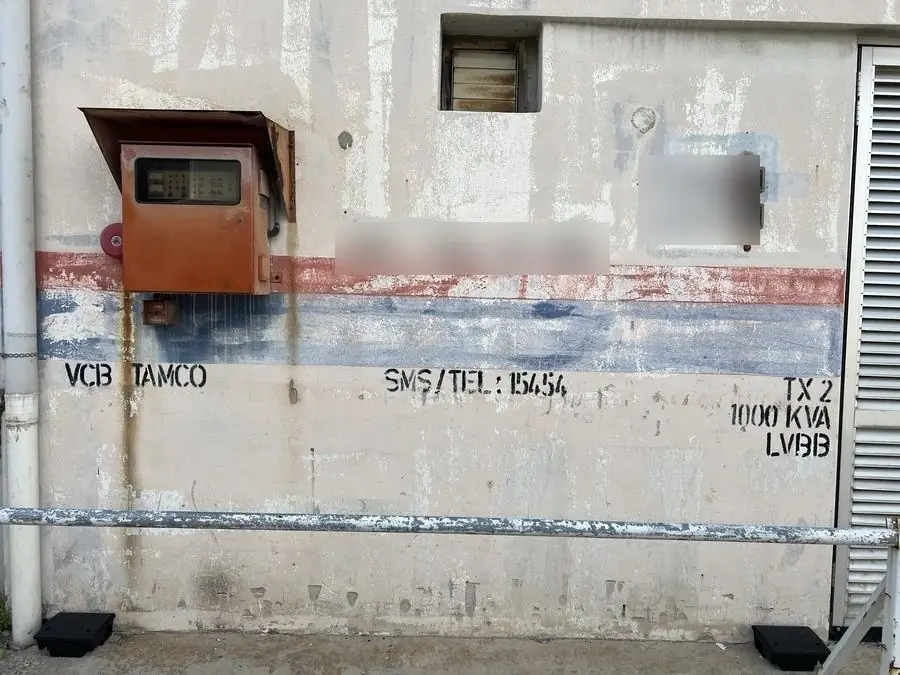
Reading the substation door
If you get to look inside, a few labels tell you most of what matters.
TX 1, TX 2. The transformer number. If you see a unit labelled TX 2, there is very likely a TX 1 somewhere on site, which means the estate may have more total capacity than one door suggests. Worth asking.
VCB. Vacuum circuit breaker, the HV switching gear. Tamco is a common Malaysian manufacturer.
LVBB. Low voltage busbar, where the transformer output is distributed.
A named competent person. HV installations in Malaysia must be under a registered chargeman or competent person. A name and registration on the door suggests the installation is being maintained. No name is a question worth asking.
Stencilled feeder references and a TNB fault number. These identify the incoming TNB feeders and the fault reporting line. The fault line is not an owner contact, so do not mistake it for one.
The part that costs money: maximum demand
A big supply is not free to keep.
Medium voltage customers in Malaysia are billed on a maximum demand basis. The MD charge is set by your highest recorded demand in the billing cycle, measured over a 30-minute interval, and it applies whether or not you use that much for the rest of the month.
One bad half hour sets your bill. Start three large motors together on a Monday morning and that half hour can define the demand charge for the entire month.
Unused capacity is not free capacity. Taking a larger supply than you need does not automatically cost more by itself, but a poorly managed load profile does. Staggered start-up, power factor correction and load scheduling are worth real money at this scale.
TNB tariffs were restructured from July 2025 under Regulatory Period 4. Check the current published rates rather than an older figure, because the structure itself changed, not just the numbers.
Do you actually need 1000 kVA?
Often, no.
| Use | Rough supply level |
|---|---|
| Warehousing, storage, light distribution | Low voltage is usually enough |
| Light assembly, packing, small workshop | Low voltage to low MV |
| Heavy machining, moulding, cold storage, plating | Medium voltage territory |
A pure storage warehouse with racking, lighting and a few dock levellers does not need a 1000 kVA intake. Paying a premium for power you will never draw is a waste.
But the reverse mistake is more expensive. Taking a building with a modest supply because it is cheaper, then discovering eighteen months later that your expansion needs an upgrade TNB will take months to deliver, costs far more than the premium would have.
Buy for the load you will have in five years, not the one you have on move-in day.
What to ask before you commit
- What is the allocated supply to this unit, not to the estate
- Can I see the main switchboard rating and the TNB meter
- How many units share this transformer
- Is there a second transformer on site
- Who is the registered competent person, and is there a maintenance record
- What was the previous occupier's actual maximum demand
- Is the substation inside my demised area or common property, and who maintains it
Question six is the most useful of the seven. Historic MD tells you what the building really drew, which is far more informative than a plate rating.
Frequently asked questions
Is 1000 kVA a lot for a factory?
It is a substantial supply and sits at the entry point of TNB's 11kV medium voltage band, which covers 1,000 to 5,000 kVA. It is ample for most light and medium manufacturing, but modest for heavy industry such as large scale plating, smelting or extensive cold storage.
How many amps is 1000 kVA at 415V?
Approximately 1,390 amps three-phase. The formula is kVA multiplied by 1,000, divided by the square root of 3 times the voltage.
What is the difference between kVA and kW?
kVA is apparent power, the total capacity of the supply. kW is real power, the portion that does useful work. Multiply kVA by the power factor, typically 0.85 to 0.95 in industrial settings, to get kW.
Does a 1000 kVA factory mean I get 1000 kVA?
Not necessarily. On a multi-unit estate the transformer is shared between units. Always confirm the allocated supply to your specific unit at its main switchboard, rather than relying on the transformer plate rating.
Can a factory's power supply be upgraded later?
Sometimes, but it is slow and not guaranteed. It involves a TNB application, potentially a new substation, transformer, switchgear and cabling. Treat existing capacity as a feature you are buying, not a problem you can solve later.
Power is the one specification in an industrial building you cannot negotiate, renovate or work around after the fact. Everything else, the office fit-out, the flooring, the roof, the loading bay, can be changed with money and time. The incoming supply largely cannot.
So when a listing says 1000 kVA, do not nod and move on. Ask which transformer, ask how many units share it, and ask what arrives at your own switchboard. The answer is often different from the headline, and it is always worth knowing before you sign.
Looking at an industrial building and unsure what the power actually gives you? Email me at kalvin@kalvinyoung.com. Happy to talk it through.