On a strata industrial unit you own a parcel, a petak, and you share everything outside it. The driveway, the drains, the fence, the guardhouse and usually the electrical intake are common property, maintained collectively and paid for by everybody.
Share units are the number that decides almost everything. Your maintenance charge, your sinking fund contribution, your vote on a poll and your share of the common property are all set by it, and it is built from your floor area plus any accessory parcel, weighted by a statutory formula.
There are two accounts, not one. A maintenance account for running costs, and a separate sinking fund for capital work. The sinking fund contribution is ten per cent of the charges unless a general meeting votes it higher.
And before you buy, there is a certificate you can demand for a capped fee that tells you what the previous owner left unpaid. Section 31 of the Strata Management Act 2013. Nothing here is legal advice.
What you actually own
A strata title does not describe a piece of land. It describes a box of space inside a building, and your rights to everything around that box are shared with everybody else in the scheme.
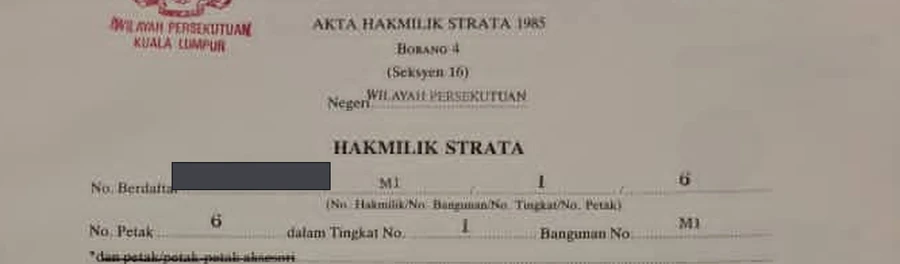
The document itself says so on its face. A strata title is issued in Form 4 under section 16 of the Strata Titles Act 1985, and the identifying line on it is not a lot number. It is a combination: title number, building number, storey number, parcel number. Petak is the parcel. That is what you own.
Everything else falls into one of two categories, and on an industrial scheme the difference is worth real money.
An accessory parcel is an area allotted to your parcel for your exclusive use but not part of the parcel itself. On an industrial scheme this is very often the yard, the loading apron or the parking bays in front of your unit. You use it exclusively. It is tied to your parcel and cannot be dealt with separately from it.
Common property is everything in the scheme that is not a parcel or an accessory parcel. The main driveway, the surface water drainage, the perimeter fence, the guardhouse, the sewage treatment plant, the shared electrical intake.
Read your own title and schedule to find out which of the space around your unit is which, because people routinely assume the concrete apron outside their shutter is theirs when it is common property, and routinely assume the strip beside it is common property when it is somebody else's accessory parcel.
Share units, the number behind your bill
Ask an owner in a strata industrial scheme what their share units are and most will not know. Ask them why their maintenance charge is what it is and they will say the management set it. Both answers have the same root.
Share units are determined for each parcel and shown in the schedule of share units, under section 4 of the Strata Titles Act 1985, and the share value for each parcel is approved by the Director and expressed in whole numbers under section 18.
The calculation is not discretionary. Section 8(1) of the Strata Management Act 2013 points to a formula in the First Schedule to that Act, and the inputs are these.
The area of your parcel. The dominant term. A bigger unit carries more share units.
The area of any accessory parcel, weighted separately. On an industrial scheme, where the yard can be a substantial proportion of what you occupy, this is not a rounding adjustment.
Three weightage factors. The first varies with the type of parcel, whether the common areas are air conditioned, and whether the parcel benefits from a common lift or escalator. The second applies to whole floor parcels. The third applies to accessory parcels and differs depending on whether they sit inside or outside a building.
That third factor is the industrial one. An external yard and an internal store are weighted differently, which is why two units with the same built up area in the same scheme can carry different share units and therefore different monthly charges.
Now what the number actually does.
It sets your contribution to the management fund, under sections 21 and 25 of the Strata Management Act. Charges are levied on a share unit basis, so the number is your bill.
It sets your voting power on a poll. Ordinary business at a general meeting is decided on a show of hands, one vote per owner. But where a poll is demanded, votes are counted by share units under section 22(2). In a scheme where a handful of large units hold a large proportion of the share units, that distinction decides who controls the scheme.
And it sets your share of the common property and your proportion of the body's liabilities.
So the first question to ask about a strata industrial unit is not what the maintenance charge is per square foot. It is how many share units does this parcel carry, and out of what total. That ratio is the whole relationship, and it is printed on the title.
The yard is probably an accessory parcel
On a detached or terrace factory on its own title, the yard is simply part of your land. On a strata industrial scheme it is not, and the distinction has consequences people meet late.
If the yard in front of your unit is an accessory parcel, it is yours to use exclusively, it is counted into your share units, and it cannot be sold or dealt with separately from the parcel. It is attached to the unit permanently.
If it is common property, you do not have an exclusive right to it at all. You may have been parking there for six years because nobody objected, which is not the same thing as being entitled to. Fencing it, roofing it, or storing on it is then a matter for the management body and the by-laws rather than for you.
And either way, altering it is not just a management question. Putting a roof over a yard, enclosing it, or building anything on it may require local authority approval in the ordinary way. A management committee saying yes is not a building approval, and that distinction is the subject of the article on unapproved extensions.
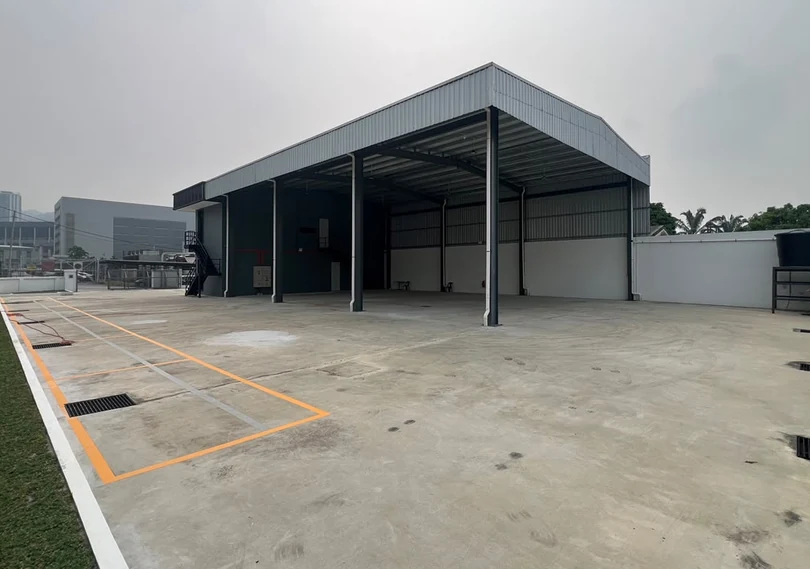
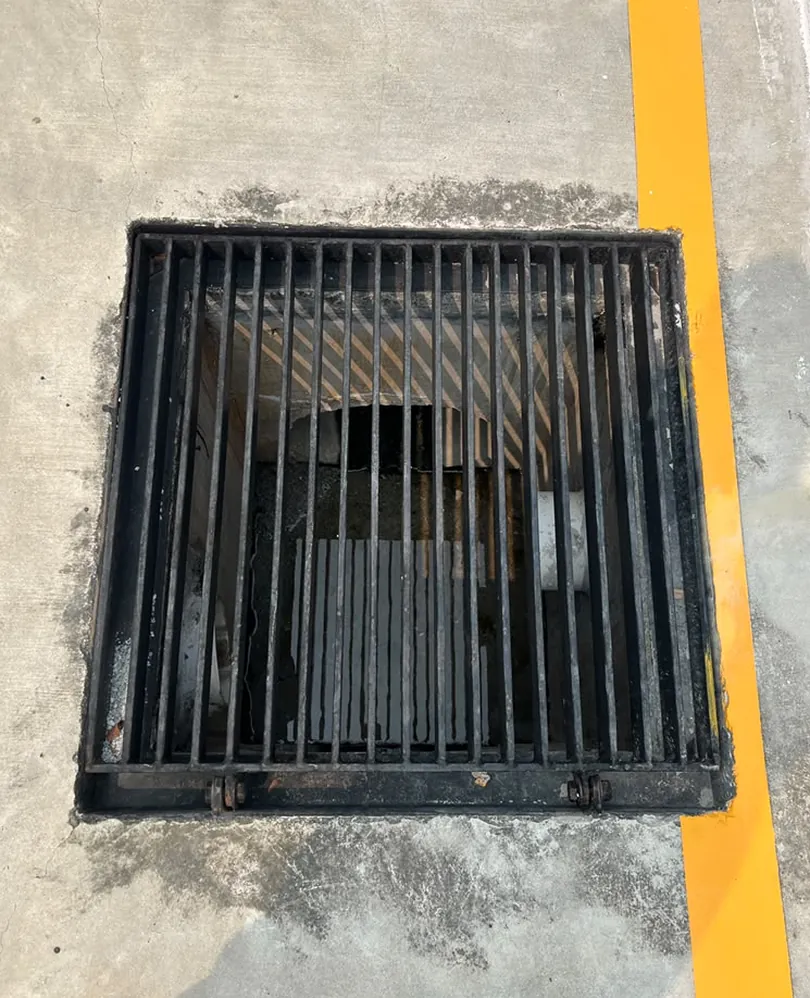
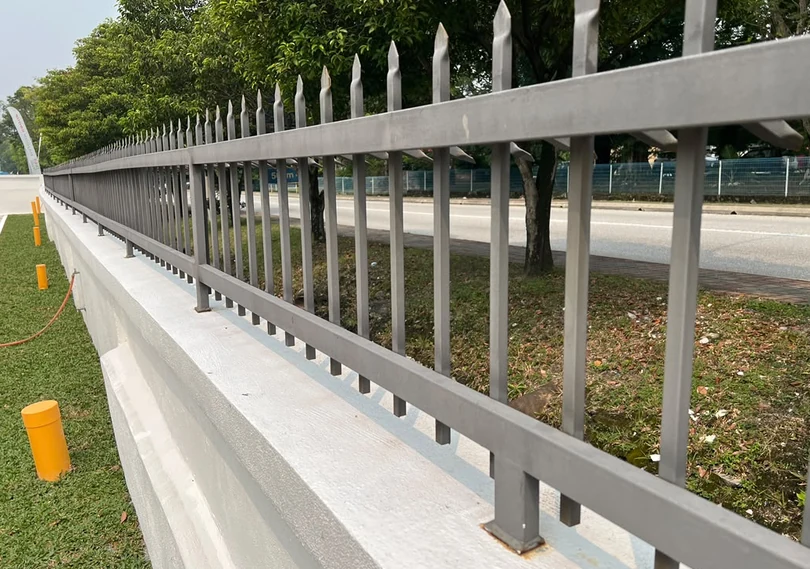
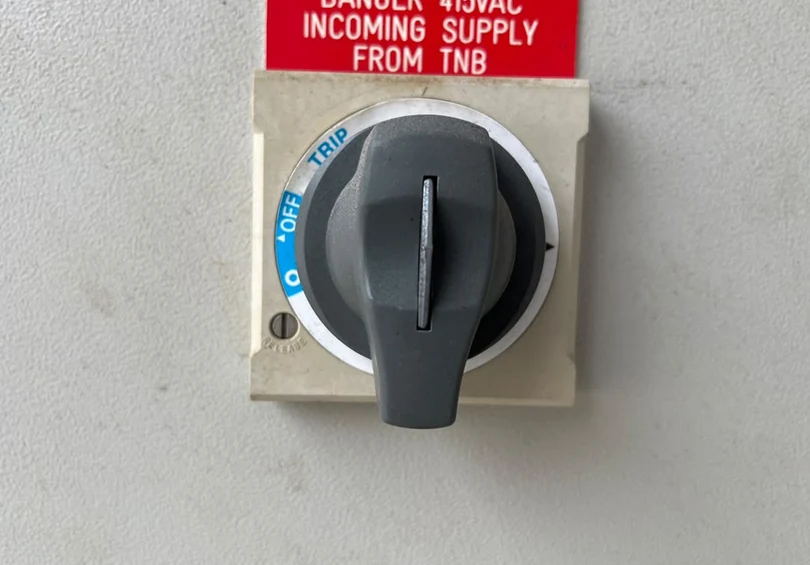
A note on the photographs from here on. Four of them show a detached factory that has just taken its CCC, and a detached factory is not a strata building at all. That is deliberate. On that site one owner holds the whole lot, so the yard, the drains, the boundary and the electrical intake are simply theirs, and nobody has to be consulted about any of it. Setting those same four things against a strata scheme is the clearest way to see what strata actually does to a building: each one stops being one person's property and becomes either an accessory parcel or common property, with a share unit attached and a management body in the middle.
What common property means when the bill arrives
Common property is a legal category, and it is also a maintenance budget. Everything in it is maintained collectively and charged back to the owners by share units.
On an industrial scheme the list is longer and more expensive than people expect. The main driveway and the turning areas, which carry lorries rather than cars and fail accordingly. Surface water drainage, the gratings, the sumps and the interceptor. The perimeter fence and the gate. The guardhouse, and with it the security contract. Street lighting. The sewage treatment plant where the scheme has its own. And frequently the electrical intake and the substation compound.
Two of those deserve a second look before you buy.
Drainage, because industrial yards shed a lot of water and an industrial scheme's drains take a beating from vehicles. A blocked or collapsed drain in a shared yard is a common property repair, which means a sinking fund question, which means a special resolution and a levy if the fund is thin.
The driveway, because resurfacing one is the single largest predictable capital cost in most industrial schemes, and it is exactly the thing a weak sinking fund fails to cover.
Who actually runs the scheme, and when it changes hands
Management passes through three stages, and knowing which stage a scheme is in tells you a great deal about what you are buying into.
The developer. During the preliminary period the developer manages the property, under section 48 of the Strata Management Act 2013. The developer keeps the accounts, files audited statements, and must hand over control of the funds and the records by the end of that period under section 55. Unsold parcels are charged to the developer as if they had been sold, under section 25(2), which matters because a scheme that is half unsold is half funded by the developer.
The Joint Management Body. A JMB is formed with a joint management committee elected under section 22. It keeps the maintenance account and the sinking fund account and runs the scheme until strata titles have issued and a management corporation exists.
The Management Corporation. The MC comes into being once strata titles are issued. The developer must convene the first annual general meeting within one month after the initial period ends, under section 57, and if the developer does not, the Commissioner of Buildings can appoint somebody to do it under section 57(5). The JMB then dissolves three months after the MC's first AGM, transferring its funds and records, under section 27. The MC elects a management committee under section 56 and carries the duties and powers in section 59.
Over all of it sits the Commissioner of Buildings, the COB, at the local authority. The COB can investigate the accounts at any time, can fix the amount where an owner disputes charges set by a developer under section 52(6) and (7), and can issue warrants of attachment for unpaid sums under section 35.
Why this matters to a buyer. A scheme still in the developer's hands has no owner control, no elected committee and no track record you can inspect. A scheme with a functioning MC has minutes, audited accounts and a sinking fund balance, and all three are documents you can ask for.
Two accounts, and the ten per cent
This is the part owners most often get wrong, because they treat the monthly charge as one number.
The maintenance account pays the running costs. Cleaning, security, insurance premiums, inspections, routine upkeep of the common property, management fees. Sections 23, 50 and 60 depending on who is running the scheme.
The sinking fund account pays capital costs. Repainting, replacing fixtures, buying movable property, upgrading and improving the common property. Sections 24, 51 and 61. It must be kept separate from the maintenance account and used only for its designated purposes.
The contribution rate is set by statute as a floor. The sinking fund contribution is ten per cent of the Charges, under sections 25(4), 52(3) and 61(3). A general meeting can resolve to pay more. It cannot resolve to pay less.
Charges are payable within fourteen days of a notice demanding them, and late payment can attract interest, capped at ten per cent per annum.
One provision is specifically useful on industrial schemes. Section 60(3)(b) allows a management corporation to set rates that are not based on share units in two situations, one of which is where parcels are used for significantly different purposes. In a mixed scheme where some parcels are heavy production and others are storage or showroom, that is the mechanism for charging differently, and it requires a decision rather than happening by itself.
Two things to look at in the accounts of any scheme you are buying into. The sinking fund balance against the obvious upcoming capital items, which on an industrial scheme means the driveway, the drainage and the fencing. And the arrears figure, because a scheme where a large proportion of owners are not paying is a scheme where the paying owners eventually fund a special levy.
The intake, and who owns the bit before your meter
On a strata industrial scheme the electrical supply arrangement is one of the more expensive ambiguities, and it is worth settling before you commit.
Where the scheme has a shared substation and a common intake, that equipment is generally common property. Maintenance, testing and eventual replacement are collective costs, and the capacity available to any one unit is a function of the whole scheme rather than of your parcel.
Where each unit has its own supply and its own meter, the position is simpler, and the capacity question is the one set out in the article on what a 1000 kVA supply actually means.
The questions to ask are short. Is the intake common property or is it mine. What capacity is allocated to this parcel, and is that allocation recorded anywhere. Who maintains and tests the shared equipment, and out of which account. And if I need more capacity than the parcel was allocated, whose permission do I need and whose infrastructure has to change.
The last one is the one that stops fit outs. A scheme designed around modest unit demand does not accommodate one tenant installing something substantially heavier without an upgrade, and that upgrade is a scheme level decision.
Before you buy, and the certificate most buyers never ask for
Everything in the previous article on buying a let building applies here too. These are the additional items that exist only because the unit is strata.
One. The section 31 certificate. This is the most useful provision in the Act for a buyer and almost nobody uses it. A prospective purchaser may obtain from the management body a certificate showing the sums due and payable in respect of the parcel, and the fee for it is capped at RM50. That single document tells you whether you are buying into arrears.
Why it matters so much: charges and sinking fund contributions are recoverable from the proprietor or his successor in title, under sections 60(4) and 61(4). Arrears can follow the parcel to you. The certificate is how you find out before completion rather than after.
Two. The written requisition for repair costs. Section 59(5) gives a purchaser a specific protection against amounts a management corporation has spent on repairs before the purchase, provided a written requisition was made within twenty one days before acquiring the parcel and the MC either certified that nothing was owed or failed to reply within fourteen days. That is a short, dated window and it has to be used deliberately.
Three. The share unit figure, and the total. From the title and the schedule, not from the agent.
Four. The last two years of audited accounts, the sinking fund balance and the current arrears figure for the scheme.
Five. The by-laws, including any additional by-laws the scheme has adopted. Industrial schemes commonly restrict operating hours, outdoor storage, vehicle sizes and signage, and all four can collide with how you intend to use the unit.
Six. Whether individual strata titles have issued at all. If they have not, a title search returns the master title and tells you nothing about your parcel, including nothing about who holds it or what is charged against it. That trap is covered in the title search article, and on strata industrial schemes it comes up more often than people expect.
What this page is, and what it is not
This is how strata works on industrial schemes in Peninsular Malaysia and where it catches owners and buyers. It is not conveyancing advice and it is not a reading of any particular scheme's documents.
Three warnings. Share units are calculated under a statutory formula and the figures depend on the schedule for your scheme, so no worked example is given here. Sabah and Sarawak have their own legislation, and the Acts cited are Peninsular Malaysia. And the by-laws and the schedule of parcels for your own scheme beat anything on this page. Whether a particular area is an accessory parcel or common property, and what your management body may or may not charge you, are questions for those documents and for a solicitor reading them.
Related
- You buy the building, you inherit the tenant, for everything about a purchase that is not strata specific
- The flyer is marketing, the geran is the deal, including what a search returns when strata titles have not yet issued
- A tenancy is a promise, a lease is on the title, if you intend to let the parcel
- One tax is on the land, the other is on the building, which on a strata parcel is charged as cukai petak
- What a 1000 kVA supply actually means, for the capacity question behind the intake
- The extension is built, the approval is not, for roofing or enclosing a yard
- Versi Bahasa Melayu: unit syer dan caj penyelenggaraan kilang strata
Frequently asked questions
What is a petak in a strata title?
Petak is the parcel, which is the unit you own. A strata title is issued in Form 4 under section 16 of the Strata Titles Act 1985, and what identifies the property on it is not a lot number but a combination of title number, building number, storey number and parcel number. Everything outside the parcel is either an accessory parcel allotted for the exclusive use of a particular parcel, or common property belonging to all the owners collectively.
What is the difference between an accessory parcel and common property?
An accessory parcel is an area allotted to a particular parcel for its exclusive use, but it is not part of the parcel itself and it cannot be dealt with separately from it. On an industrial scheme the yard, the loading apron or the bays in front of a unit are very often accessory parcels. Common property is everything in the scheme that is neither a parcel nor an accessory parcel: the main driveway, the drainage, the perimeter fence, the guardhouse, the lighting, and frequently the electrical intake. You cannot tell which is which by looking at the concrete. It is in the schedule.
How are share units calculated in Malaysia?
By a statutory formula rather than by anyone's discretion. Section 8(1) of the Strata Management Act 2013 points to a formula in the First Schedule to that Act. The inputs are the area of the parcel, the area of any accessory parcel weighted separately, and three weightage factors: one for parcel type and whether common areas are air conditioned or served by a lift, one for whole floor parcels, and one for accessory parcels that differs depending on whether they are inside or outside a building. The resulting share value for each parcel is approved by the Director and expressed in whole numbers under section 18 of the Strata Titles Act 1985.
What do share units actually decide?
Four things. Your contribution to the management fund, because charges are levied on a share unit basis under sections 21 and 25 of the Strata Management Act 2013. Your voting power on a poll, because although ordinary business is decided on a show of hands with one vote per owner, a poll is counted by share units under section 22(2). Your share of the common property. And your proportion of the management body's liabilities. So the question to ask about a parcel is how many share units it carries and out of what total, because that ratio is the whole relationship.
Why do two units of the same size pay different maintenance charges?
Usually because of the accessory parcels. The formula weights an accessory parcel separately from the parcel itself, and it applies a different weighting depending on whether the accessory parcel sits inside or outside a building. On an industrial scheme, where a yard can be a large proportion of what an occupier uses, two units with the same built up area can carry meaningfully different share units. Separately, section 60(3)(b) allows a management corporation to set rates that are not share unit based where parcels are used for significantly different purposes, which is a deliberate decision rather than something that happens by itself.
What is the sinking fund and how much is it?
It is a separate account for capital costs: repainting, replacing fixtures, buying movable property, upgrading and improving the common property. It is distinct from the maintenance account, which covers running costs such as cleaning, security, insurance and routine upkeep. The contribution is ten per cent of the Charges under sections 25(4), 52(3) and 61(3) of the Strata Management Act 2013. A general meeting can resolve to contribute more than that. It cannot resolve to contribute less.
Who manages a strata scheme, and when does it change?
Three stages. The developer manages during the preliminary period under section 48, is charged for unsold parcels as if they were sold under section 25(2), and hands over the funds and records by the end of that period under section 55. A Joint Management Body then runs the scheme with a committee elected under section 22. Once strata titles have issued, a Management Corporation comes into being, its first annual general meeting is convened within one month after the initial period ends under section 57, and the JMB dissolves three months later under section 27. The Commissioner of Buildings at the local authority oversees all of it.
What is the Commissioner of Buildings and what can they do?
The COB sits at the local authority and supervises strata management. Among other powers, the COB can investigate the accounts at any time, can fix the amount where an owner disputes charges set by a developer under section 52(6) and (7), can appoint somebody to convene the first annual general meeting if the developer fails to do so under section 57(5), and can issue warrants of attachment for unpaid sums under section 35. If a dispute with a management body cannot be resolved, the COB and the Strata Management Tribunal are the routes rather than the ordinary courts in the first instance.
Am I liable for maintenance arrears left by the previous owner?
This is the reason to get the certificate before completion. Charges and sinking fund contributions are recoverable from the proprietor or his successor in title under sections 60(4) and 61(4) of the Strata Management Act 2013, so arrears can follow the parcel. There is a separate and narrower protection in section 59(5) covering repair costs a management corporation incurred before the purchase, which applies only if a written requisition was made within twenty one days before acquiring the parcel and the MC either certified nothing was owed or failed to reply within fourteen days.
What is the section 31 certificate and why does it matter?
Under section 31 of the Strata Management Act 2013 a prospective purchaser can obtain from the management body a certificate showing the sums due and payable in respect of the parcel, and the fee for it is capped at RM50. It is the cheapest protection in a strata purchase and most buyers never ask for it. Given that arrears are recoverable from a successor in title, a document costing at most RM50 that tells you what is outstanding is not optional diligence, it is the first thing to request.
Can I put a roof over my yard or enclose it?
Two separate permissions and people forget the second. First, whether the yard is your accessory parcel or common property, which decides whether you have any exclusive right to it and whether the management body has to consent under the by-laws. Second, whether the work needs local authority approval, which it may well do regardless of what the management committee says. A management committee saying yes is not a building approval, and enclosing or roofing a yard on an industrial scheme is exactly the sort of work that gets built without one.
What should I check if the strata titles have not been issued yet?
That a title search will return the master title for the whole development and tell you nothing about your parcel, including nothing about who holds it or what is charged against it. Until individual strata titles issue there is no Management Corporation, so the scheme is being run by the developer or by a Joint Management Body, and you should ask which, ask for the accounts, and ask where the strata application has reached. Buying into a scheme without titles is common and workable, but it means the ordinary search gives you much less than you think it does.
References
- Laws of Malaysia, Attorney General's Chambers. The Strata Titles Act 1985 for Form 4 at section 16, share units at section 4 and the approval of share value at section 18; and the Strata Management Act 2013 for the share unit formula at section 8(1) and the First Schedule, charges at sections 21 and 25, poll voting at section 22(2), the certificate at section 31, the warrant of attachment at section 35, the developer period at sections 48 to 57, the management corporation at sections 56 to 62, and the sinking fund rate at sections 25(4), 52(3) and 61(3). As with the other articles on this site, I was not able to open these from my own machine, so I am sending you to the source rather than quoting them as read
- Halim Hong & Quek, on the determinants of share units and their significance. This is the source for the composition of the formula, the three weightage factors, and the account of what share units decide, including the section 60(3)(b) exception for parcels used for significantly different purposes
- Low & Partners, on the Strata Management Act 2013. This is the source for the two accounts, the ten per cent sinking fund contribution, the fourteen day payment period, the stages of management, the Commissioner of Buildings powers, and the section 31 certificate with its RM50 cap
- Ministry of Housing and Local Government, and your own local authority's Commissioner of Buildings, for the scheme's filings and for disputes with a management body
- The schedule of parcels and the by-laws for your own scheme, and a solicitor practising conveyancing in the state concerned, for whether a particular area is an accessory parcel or common property and for anything turning on arrears
Note on this article. It explains, in general terms and as at 21 October 2026, how strata works on industrial schemes in Peninsular Malaysia. No share unit figures and no maintenance rates are given here, because both are specific to a scheme and the formula is statutory. The section numbers and the ten per cent and RM50 figures are reported from the practitioner sources named above rather than from the Acts themselves, so verify them against the legislation before relying on them. Sabah and Sarawak have their own legislation. The photographs are my own, taken on a visit, and are cropped so that no building, business, person or vehicle is identifiable. Four of them show a detached factory rather than a strata scheme, used as a comparison and labelled as such where they appear. The strata title shown is reproduced with its registered title number removed, and no owner, property or transaction is identified. I am not a solicitor or a licensed property manager, and nothing on this page is legal, financial or management advice.