A qualified title, Hakmilik Sementara, is a real title that can be dealt with in the ordinary way. It is issued before the land has been finally surveyed, and the area printed on it is labelled provisional. The document says so itself, in the field name.
That matters because industrial land is priced per square foot. If the agreed price is the rate multiplied by an area that is not final, then the price is not final either, unless the agreement says what happens when the number moves.
The final title issues after a licensed surveyor has surveyed the land and a certified plan has been approved. That is a process with its own queue, and it is not usually inside your completion period.
Read the words on the title, not the shape of it. The field that matters is the one that says Luas Sementara. Nothing here is legal, valuation or survey advice.
What a qualified title is, and why it exists
Land has to be surveyed before a final title can issue, and surveying takes time. Rather than leave an owner holding nothing while the queue moves, the system issues an interim document that is a real, registrable title, with the area stated on the basis of what is known so far.
That is a qualified title. In Malay, Hakmilik Sementara. Practitioner guidance puts the issuing power at section 92 of the National Land Code and the conversion to a final title at section 96.
Two things follow, and people usually only know one of them.
It is a proper title. It is registrable, and dealings go on it in the ordinary way. It is not a letter of offer, not a booking form, and not a promise of a title to come.
And the area on it is not final. That is the entire point of the word qualified. The title is good; the measurement is pending.
You will meet them in two situations in particular. Land freshly alienated by the state, and land that has been subdivided, which includes almost every scheme where a developer has cut a master lot into units.
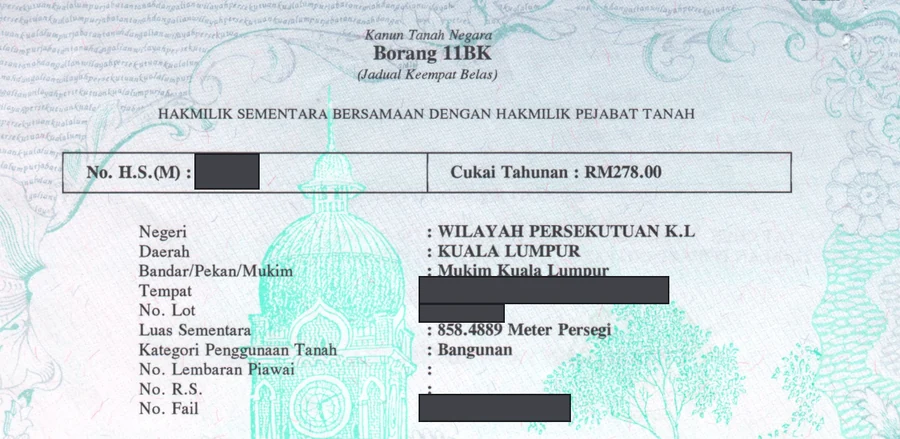
The word on the document is Sementara
Of all the fields on a Malaysian title, this is the one most often read without being noticed. It does not say Luas Tanah, land area. It says Luas Sementara, provisional area, and that adjective is doing all the work.
Look at the figure above. The area is given as 858.4889 square metres. Four decimal places on a square metre is a tenth of a square centimetre. That is precision to the width of a pencil line, printed on a number the same document has just told you is not final.
This is not a criticism of the form. It is the arithmetic of a computed area, carried out to the decimals the calculation produced. But it is a useful thing to notice, because that run of decimals is exactly what makes a provisional figure feel authoritative, and it is what a valuation, a flyer and a price per square foot all get built on.
One more caution from the same document, and it is the reason to read rather than pattern match. A lot of general guidance says that a PT number means a provisional area and a lot number means a final one. The title in the figure carries a lot number and a provisional area at the same time. So do not infer the status of the measurement from the shape of the reference. Read the field name.
HSD or HSM, and which office holds it
Qualified titles come in two kinds, on the same split described in the article on title searches, and going to the wrong office wastes a day.
HSD, Hakmilik Sementara Daftar, is the Registry title version, held at the state Pejabat Tanah dan Galian. Registry titles cover town land, village land, and country land above the area threshold.
HSM, Hakmilik Sementara Mukim, is the Land Office version, held at the Pejabat Daerah dan Tanah for the district. It covers country land up to the threshold.
The title in the figure reads No. H.S.(M), so it is a Land Office qualified title, and the words across the top of the form say the same thing in full. The form name itself is printed on the document. Read it before you decide which counter to queue at.
What a provisional area does to a price per square foot
Industrial land is quoted per square foot. That is the convention, it is in every flyer, and it is the subject of its own article, because the rate is useless until you know which area it is being applied to.
Here the problem is narrower and sharper. The rate may be firm and the area may not be.
Work it through. A price is agreed as a rate multiplied by the area on the title. The title says that area is provisional. The land is then surveyed, the certified plan is approved, and the final title issues with a number on it. If that number is not the number in your calculation, then one of three things has to happen: the price moves, somebody absorbs the difference, or there is an argument.
Which of the three it is was decided months earlier, by whether anybody put a clause in the sale agreement.
On a small residential lot the difference is usually noise. On an industrial lot it is not, for two reasons. The areas are larger, so the same percentage variance is a larger absolute number. And the rate per square foot is the unit everyone has agreed to think in, which means a movement in area converts directly and visibly into money.
That is the whole of it. Not a hidden defect, not a trap, just a figure that was always labelled provisional being treated by everyone involved as though it were not.
The clause that should be in the agreement, and usually is not
If the land you are buying sits on a qualified title, the sale agreement should say in terms what happens when the final area is known. There are only a few sensible answers and the point is to pick one on purpose.
Adjust the price at the agreed rate. The consideration is recalculated at the same rate per square foot against the surveyed area, up or down, with the balance paid or refunded on a stated timetable. Clean, symmetrical, and the version that matches what both sides thought they were agreeing.
Adjust only beyond a tolerance. No adjustment unless the variance exceeds an agreed percentage, which keeps small movements from reopening a completed transaction. Then decide whether the adjustment applies to the whole variance or only the part beyond the tolerance, because those are different numbers.
Fixed price, no adjustment either way. Legitimate, and sometimes what a seller insists on. Just make sure it is a decision rather than a silence, and that it is priced.
And a right to withdraw beyond a larger variance. If the land comes back materially smaller than described, the question is not only price but whether the thing is still usable for what you intended. A building footprint, a yard and a setback do not shrink proportionally.
The one option that is not sensible is the one most agreements take, which is to say nothing and hope the number does not move.
What has to happen before the final title issues
The route is the same wherever the land is, and none of it is quick.
A licensed land surveyor surveys the land. Not the developer's setting out, not the architect's plan. A licensed surveyor producing survey data in the form the authority requires.
The survey goes to JUPEM, the Department of Survey and Mapping, for checking.
A certified plan is approved. The Pelan Akui is the document that carries the certified result: the lot number, the bearings, the boundaries and the surveyed area. Guidance on this cites section 396(e) of the National Land Code for the proposition that land is not treated as surveyed until a certified plan has been approved by the Director of Survey and Mapping.
The land office then issues the final title, with a permanent lot number and the surveyed area on it, replacing the qualified title.
How long. Published guidance puts it at several months to over a year, and it is driven by a queue you do not control. So do not write it into a completion period. If something in your transaction genuinely depends on the final title existing, that is a condition to be negotiated with its own long stop date, not an assumption to be carried.
The practical question to ask the seller is short and it tells you a great deal. Has the survey been done, and is there a certified plan? If the answer is yes, ask for the plan number and get a copy, because the surveyed area on it is the real number and it may already exist while everybody is still quoting the provisional one.
Can you transfer it, charge it and let it
Yes. A qualified title is a registrable title and dealings go on it in the ordinary way. Transfers are registered, charges are registered, and a lease exceeding three years is registrable on it exactly as set out in the article on tenancies and leases. Nothing about the word qualified suspends the ordinary machinery.
Where it does bite is financing. Published guidance notes that banks prefer final titles, and the reason is not mysterious. A lender is securing against an asset whose extent is stated provisionally, and the valuation it relies on is computed from that same provisional figure.
In practice that can show up as a more conservative margin, extra conditions, or a longer credit process. It is worth raising with the bank early rather than discovering it at the offer letter, particularly on an industrial purchase where the loan is doing most of the work.
The strata version of the same problem
There is a close relative of this on strata schemes, and it catches people in the same place.
Where individual strata titles have not yet issued, a search returns the master title for the whole development. It tells you about the parcel of land the scheme sits on and nothing at all about your unit: not who holds it, not what is charged against it, and not what share units it carries. That is set out in the strata article.
The common thread is worth stating plainly. In both cases there is a real transaction happening against a document that is not yet in its final form, and in both cases the sensible response is the same: ask where in the process it has reached, ask for the evidence, and write the answer into the agreement rather than assuming it.
Before you commit, on a qualified title
Six questions, and the first four can be answered before you have paid anybody anything.
One. Is it HSD or HSM, and which office holds it? Read the top of the title. It tells you where to search.
Two. What does the area field actually say? If the words are Luas Sementara, treat the figure as open.
Three. Has the land been surveyed, and is there a certified plan? If yes, get the plan and the area on it. If no, ask where the application stands.
Four. What is the rest of the title saying? Proprietor, tenure, category, express conditions, restriction in interest, encumbrances. All of the title search work applies here unchanged.
Five. What does the agreement say happens if the area changes? One of the four positions above, chosen deliberately.
Six. What does the bank say? Before the agreement, not after.
What this page is, and what it is not
This explains what a qualified title is, why its area is provisional, and what that does to a transaction priced per square foot. It is not conveyancing advice and it is not survey advice.
Three warnings. The section numbers here are reported from practitioner sources rather than read off the statute, and they are given so you can look them up, not so you can rely on them. Sabah and Sarawak have their own land legislation, and the provisions cited are Peninsular Malaysia. And no worked example or tolerance figure is given, because what is reasonable varies with the size of the lot and the deal, and because the only area that matters is the one on your own title.
Related
- The flyer is marketing, the geran is the deal, for the search itself and the five fields that decide whether a transaction can complete
- Psf on land, psf on built up, and the trap inside it, because the rate is useless until you know which area it is applied to
- The unit is yours, the yard is everyone's, for the strata version of buying against a document that is not final
- You buy the building, you inherit the tenant, for the rest of the purchase mechanics
- One tax is on the land, the other is on the building, for the Cukai Tahunan printed on the title above
- Leasehold or freehold, check the geran not the flyer
- Versi Bahasa Melayu: hakmilik sementara dan luas sementara
Frequently asked questions
What is a qualified title in Malaysia?
A qualified title, Hakmilik Sementara, is a title issued before the land has been finally surveyed. It is a real, registrable title: transfers, charges and leases are registered on it in the ordinary way. What is not final is the measurement. The area printed on it is labelled Luas Sementara, provisional area, and it is replaced by a surveyed figure when the final title issues. Practitioner guidance puts the issuing power at section 92 of the National Land Code and the conversion at section 96.
What does Luas Sementara mean on a land title?
Provisional area. It is the area as computed before the land has been finally surveyed, and the adjective is the important part of the phrase. It is worth noticing that these figures are often quoted to four decimal places of a square metre, which is a tenth of a square centimetre, on a number the same document has just described as not final. That run of decimals is what makes a provisional figure feel authoritative, and it is what valuations and prices per square foot get built on.
Is it safe to buy land on a qualified title?
It is done constantly and it works, provided you understand what is open. The title itself is sound and dealings register normally. The exposure is the area, because industrial land is priced per square foot and a provisional area multiplied by a firm rate produces a price that is only as final as the measurement. Handle it in the agreement rather than by hoping: say what happens if the surveyed area differs, and decide whether anything in your transaction genuinely needs the final title to exist first.
What is the difference between HSD and HSM?
They are the same thing under the two title systems. HSD, Hakmilik Sementara Daftar, is the Registry version, held at the state Pejabat Tanah dan Galian, and Registry titles cover town land, village land and larger country land. HSM, Hakmilik Sementara Mukim, is the Land Office version, held at the Pejabat Daerah dan Tanah for the district, covering country land up to the area threshold. Read which one is printed on the title before deciding where to search, because going to the wrong office does not give you a wrong answer, it gives you no answer.
Does a PT number mean the area is provisional and a lot number mean it is final?
That is the general rule you will see quoted, and it is a useful rough guide, but do not rely on it. A qualified title can carry a lot number and a provisional area at the same time. The reliable test is not the shape of the reference, it is the field name. If the area line reads Luas Sementara, the figure is provisional whatever else the document says.
How does a qualified title become a final title?
A licensed land surveyor surveys the land, the survey goes to JUPEM for checking, a certified plan is approved, and the land office then issues the final title with a permanent lot number and the surveyed area on it. Guidance cites section 396(e) of the National Land Code for the position that land is not treated as surveyed until a certified plan has been approved by the Director of Survey and Mapping. Published estimates put the whole process at several months to over a year, driven by a queue nobody in the transaction controls.
What is a certified plan or Pelan Akui?
It is the survey document prepared in the form the Department of Survey and Mapping requires and approved by the Director of Survey and Mapping. It carries the location, the lot number, the bearings, the boundaries and the lot size, and it is required when converting a qualified title to a final title. For a buyer the useful point is simple: if a certified plan already exists, the surveyed area on it is the real number, and it may exist while everyone in the transaction is still quoting the provisional one. Ask for the plan number and get a copy.
What happens if the surveyed area is different from the area on the title?
Whatever the sale agreement says, which is why the clause matters. There are four sensible positions: recalculate the price at the agreed rate per square foot against the surveyed area, adjust only where the variance exceeds a stated tolerance, fix the price with no adjustment either way, or allow a right to withdraw where the shortfall is large enough to break what you intended to build. All four are defensible. Saying nothing is not a position, it is a gap, and on an industrial lot the sums involved are large enough that somebody will want to argue about it.
Can I get a bank loan on a qualified title?
Generally yes, and published guidance notes that lenders prefer final titles. The reason is that the security and the valuation both rest on an area stated as provisional. In practice that can mean a more conservative margin, additional conditions or a longer credit process rather than a refusal. Raise it with the bank before you sign rather than after, particularly on an industrial purchase where the financing is carrying most of the price.
Can I transfer or charge land on a qualified title?
Yes. A qualified title is registrable and dealings go on it in the ordinary way, including transfers, charges, and leases exceeding three years. The word qualified refers to the state of the survey, not to the strength of the title or to any limitation on dealing with it. Restrictions in interest and consent requirements apply on their own terms, exactly as they would on a final title, so read the endorsements rather than assuming either way.
Does a qualified title affect the quit rent?
The annual quit rent is printed on the face of the title in the ordinary way, as Cukai Tahunan, and it is payable in the ordinary way. What is worth remembering is that quit rent is assessed by reference to the land, so if the surveyed area turns out to differ materially from the provisional one, the figure can be revisited when the final title issues. Treat the quit rent on a qualified title the same way you treat the area on it: correct for now, and not necessarily permanent.
What is the strata equivalent of this problem?
A development where individual strata titles have not yet been issued. A search then returns the master title for the whole scheme and tells you nothing about your parcel, including nothing about who holds it, what is charged against it, or what share units it carries. The pattern is the same as a qualified title: a real transaction proceeding against a document that is not yet in its final form. The response is the same too. Ask where the application has reached, ask for the evidence, and write the answer into the agreement.
References
- Laws of Malaysia, Attorney General's Chambers, for the National Land Code itself. The sections referred to on this page are 92 on the issue of qualified titles, 96 on conversion to final title, 340 on indefeasibility and 396(e) on when land is treated as surveyed. As with the other articles on this site, I was not able to open these from my own machine, so I am sending you to the source rather than quoting them as read
- Khidmat Guaman, on final title and qualified title. This is the source for the section numbers 92, 96, 340 and 433, for the conversion route through a licensed surveyor and JUPEM, and for the several months to over a year estimate and the point about lenders preferring final titles
- Agility Valuers, on how to read Malaysian land and strata titles. This is the source for the HSD and HSM split, the forms, and which office holds which
- EasyLaw, on the certified plan or Pelan Akui. This is the source for what a certified plan contains, for its role in converting a qualified title, and for the reference to section 396(e). It is a commercial extraction service, so treat the procedure as indicative and confirm with JUPEM
- Jabatan Ukur dan Pemetaan Malaysia, for survey and certified plans, and your state Pejabat Tanah dan Galian or district Pejabat Daerah dan Tanah for the title itself
- A licensed land surveyor for the measurement, and a solicitor practising conveyancing in the state concerned for the agreement and for the area adjustment clause
Note on this article. It explains, in general terms and as at 22 October 2026, what a qualified title is in Peninsular Malaysia and what its provisional area does to a transaction priced per square foot. The section numbers are reported from the practitioner sources named above rather than read off the statute, and are given so that you can look them up rather than rely on them. No tolerance figure and no worked example is offered, because what is reasonable depends on the lot and the deal. Sabah and Sarawak have their own land legislation. The photographs are my own, taken on a visit, and are cropped so that no building, business, person or vehicle is identifiable. The title reproduced here is a house title rather than an industrial one, used because the fields are identical whatever the category, and it is shown with its title number, address, lot number and file number removed, so no owner, property or transaction is identified. I am not a solicitor, a licensed land surveyor or a valuer, and nothing on this page is legal, survey or valuation advice.