A title search is a request to the land authority for what the register currently says. Malaysia runs a Torrens system, so the register does not describe ownership, it creates it. Whatever the flyer, the agent or the seller says, the register is the version that counts.
There are two kinds. An official search, carian rasmi, is certified by the registrar and carries a compensation route if it is wrong. A private search, carian persendirian, is quicker and cheaper and carries no such protection.
Five fields decide whether a deal can complete: who the registered proprietor is, how much tenure is left, the category of land use and express conditions, any restriction in interest, and the encumbrances endorsed on the title.
And a search is accurate for one day. A caveat can be entered the next morning. You search at the start to decide whether to proceed, and again before completion to confirm nothing landed in between. Nothing here is legal advice, and the title in front of you is the only one that matters.
What a search is, and why it outranks everything else in the file
An industrial purchase generates a lot of paper. A flyer with a floor area on it. A valuation. A set of photographs. A plan the seller had drawn up years ago. Measurements someone took with a laser and wrote on the back of the plan.
All of it is description. Only one document in the pile is constitutive, and that is the register.
Malaysia runs a Torrens system. The register is not a record of who the law thinks owns the land. Registration is the thing that makes a person the proprietor. Which means a title search is not one more piece of supporting evidence to be weighed against the others. It is the fact, and everything else in the file is a claim about it.
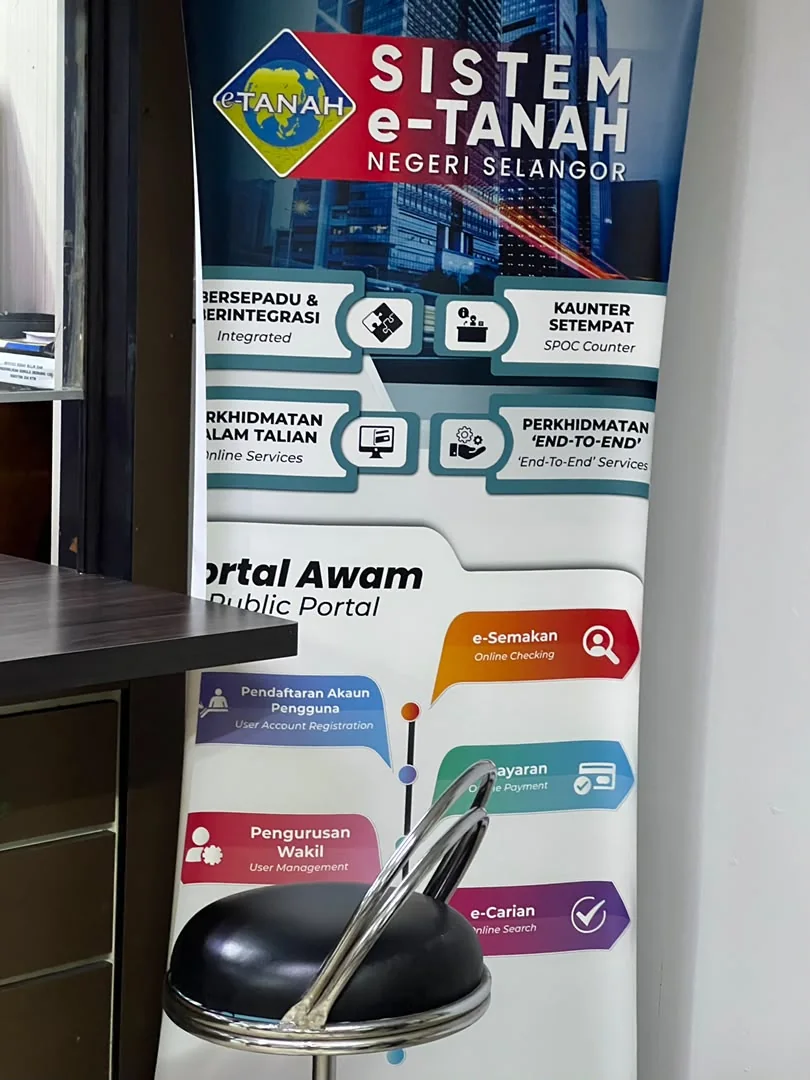
That has a practical consequence people underuse. A search is cheap and it is available before you have committed to anything. You do not need the seller's permission, you do not need a solicitor engaged, and you do not need to have paid a booking fee. If you have the title number and the lot number, you can know the shape of the deal before you have spent a ringgit on it.
Almost nobody does. The usual sequence is a viewing, a negotiation, a booking fee, a solicitor, and then a search, which is the first moment anybody looks at the thing that governs the transaction. By that point the number has been agreed and the deposit is sitting with someone.

Official search, private search, and when each one is the right tool
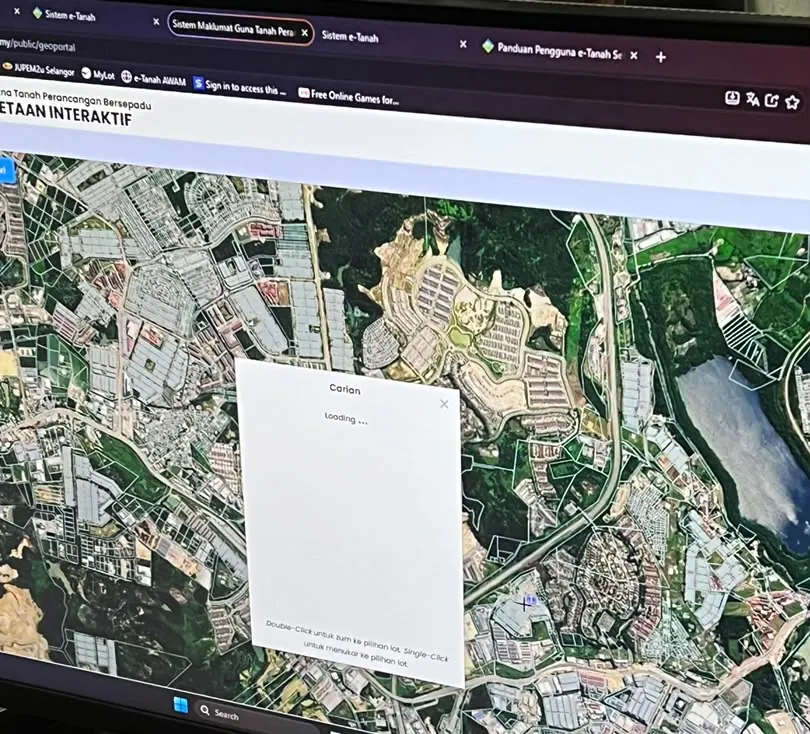
A private search, carian persendirian, returns what the register says. It is fast, it is inexpensive, and in most states some version of it can now be done online or over the counter. It is a look at the record.
An official search, carian rasmi, returns the same information in the form of a certificate issued and certified by the registrar. It costs more and takes longer. What you are buying is not better information, it is the certificate, and the fact that the National Land Code provides a route to compensation where the certified result is wrong through an error or omission.
On a normal day both show the same thing. The difference only becomes visible on the abnormal day, which is exactly when you will care about it.
So the sensible division is this. Private search when you are deciding whether this is worth pursuing. Do it early, do it yourself if you like, treat it as the first filter. Official search for the transaction, obtained by the solicitor, and again close to completion.
One warning on both. If the land is part of a development where individual titles have not yet issued, the search will return the master title. That tells you about the whole parcel and nothing about the unit, including nothing about who holds it or what is charged against it. On a strata industrial unit in a newer scheme this comes up more often than people expect, and the answer is to ask the developer, not to read the master title harder.
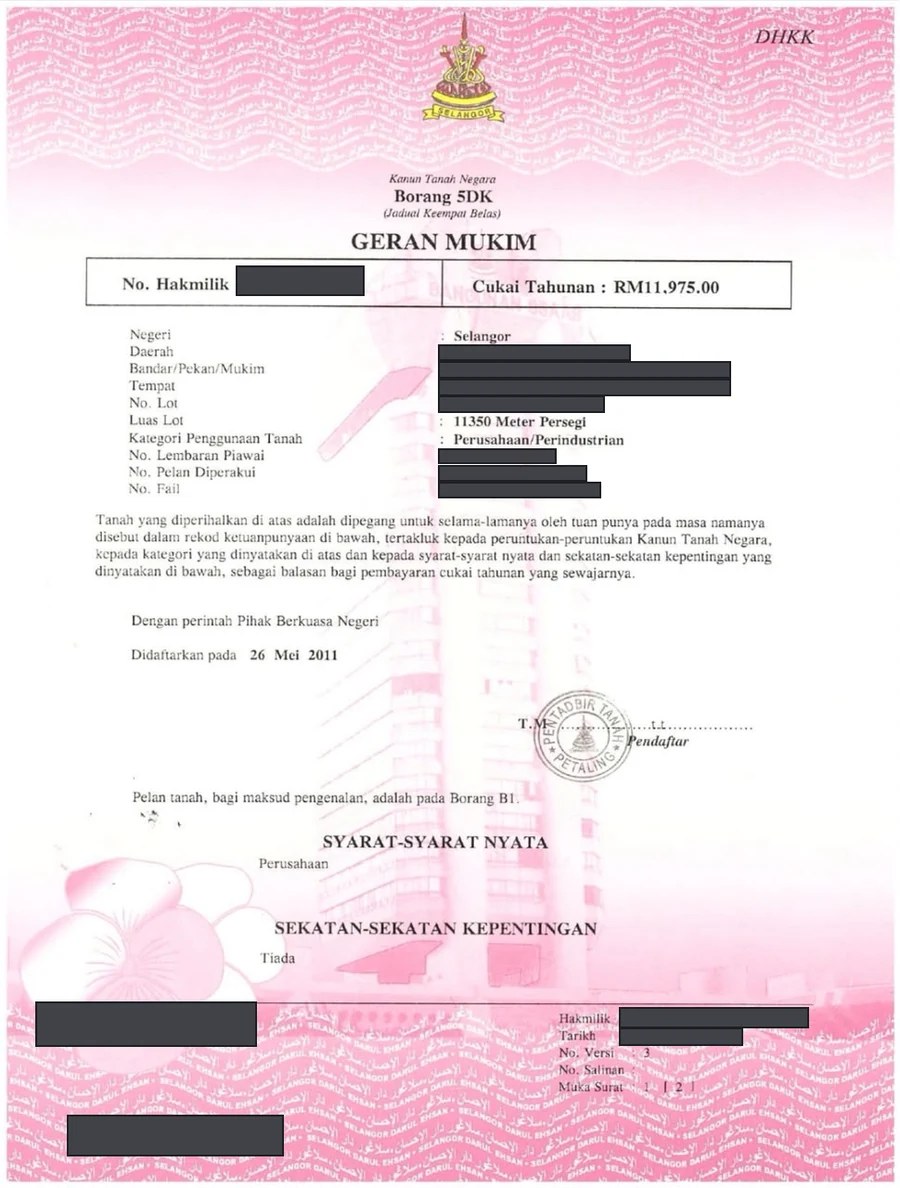
One. Who the registered proprietor actually is
The simplest field and the one that produces the most abandoned transactions.
The name on the title is the person who can transfer the land. Not the person showing you round. Not the company whose signage is on the gate. Not the director who has been running the factory for fifteen years. The registered proprietor.
On industrial property the gaps open up in predictable places. The land is held by a company and the person negotiating is one of several shareholders, which means a board resolution and possibly more signatures than anyone has mentioned. The proprietor died some years ago and the family has carried on using the building, which means the estate has to be administered and transmission registered before anything can be sold, and that is measured in months. The title is held in undivided shares between siblings, one of whom is uncontactable. Or the name on the title is close to the seller's name but not identical, because of a spelling, a marriage, or a company that has since been renamed.
None of these make a deal impossible. All of them make it longer, and all of them are visible on a search you could have done before the first viewing.

Two. The tenure, and how much of it is left
Freehold appears on the title as selama-lamanya. Leasehold appears as a term with a date on which it expires.
The field everyone reads is freehold or leasehold. The field that governs the money is the expiry date.
A lease with sixty years to run and a lease with thirty behave like different assets, because the financing behaves differently. Banks lend against the remaining term, and as it shortens, both the margin and the loan tenure tighten. That does not only affect your purchase. It affects who can buy it from you in fifteen years, and that is the number sitting inside your exit, not your entry.
This site has a separate article on tenure, so the short version here is only this: read the date, subtract, and then ask what that remainder will look like when you come to sell.
Three. The category of land use, and the express conditions under it
Under the National Land Code land carries one of three categories of land use: Pertanian, agriculture, Bangunan, building, or Perusahaan, industry. They are parallel. Industry is not a subdivision of building, which is a point worth labouring because it is misunderstood constantly, including by people selling the land.
Underneath the category sit the syarat-syarat nyata, the express conditions, and those are narrower and more specific than the category. A title in the industry category does not permit any industry. It permits what its express conditions say it permits, and those can name a trade.
For a buyer the question is not whether the category sounds right. It is whether the thing you intend to do is inside the express conditions as written. If it is not, you are looking at a variation of conditions or a change of category, which is an application to the state with a premium attached, not a form.
There is a full article on this site about the three categories and what a title actually permits, and another about the premium payable on changing them. Both are linked at the foot of this one.
Four. The restriction in interest, which is the one that eats the calendar
A sekatan kepentingan, restriction in interest, is an endorsement limiting what the proprietor may do without permission. On leasehold industrial land the usual form of words is that the land may not be transferred, leased or charged without the consent of the State Authority.
Read what that does to a transaction.
It does not prevent the sale. It inserts a government decision into the middle of it. There is an application, there is a fee, there is a queue, and there is an outcome that is a decision rather than a stamp. Consent is usually given. Usually is not a completion date.
The failure mode is almost never refusal. It is the clock. A sale agreement is signed with a three month completion and a one month extension, nobody builds the consent application into that timetable, and the parties arrive at the end of the period with the state still considering it. Then you are renegotiating an extension with a seller whose position has changed, or arguing about who is in default of a deadline that was never achievable.
If a title carries a restriction in interest, that fact belongs in the structure of the agreement before anyone signs it, not in a panicked email in month three. And it is on the search, in plain words, from the first day.
Five. The endorsements, where charges, leases and caveats live
The back of the title, or the endorsement section of a search result, is a running record of what has been registered against the land. Three things turn up there and each behaves differently.
A charge, gadaian. A bank's security for a loan. Extremely common and not an obstacle. It is discharged out of the purchase money on completion, with the seller's bank issuing a redemption statement. What matters is the number and the timing. The redemption sum is a floor under the price, and the bank's internal process sets the pace of completion regardless of what the two parties would prefer. Ask for the redemption statement early.
A lease or tenancy. A registered lease binds a buyer. On an industrial property being sold with a sitting tenant that may be exactly what you are buying, and the question becomes the terms, the remaining term and the rent rather than whether it exists. On a property being sold with vacant possession it is a direct contradiction of what you have been told, and it needs resolving before anything else happens.
A caveat, kaveat. This is the one that stops things.
A private caveat is entered under section 323 of the National Land Code, in Form 19B, by someone claiming an interest in the land. While it is on the register the registrar will not register a dealing that would defeat that claimed interest. The title is, for working purposes, frozen.
It lapses on its own six years after entry under section 328 unless renewed, which is no use to anybody on a three month completion. The practical routes are shorter. The caveator can withdraw it under section 325 in Form 19G. The proprietor can apply to the registrar under section 326 in Form 19H, which produces a notice to the caveator, and the caveat lapses two months after that notice is served unless the caveator goes to court to sustain it. Or an aggrieved person can apply to the High Court under section 327 for its removal. Section 329 provides for compensation where a caveat was entered without reasonable cause.
So a caveat is removable. It is also a separate process with its own timetable sitting inside your transaction, and often a dispute attached to it that you are now adjacent to. On a factory purchase the honest reading of a caveat on the title is that the deal has a second deal inside it.
There are also registrar's caveats and other entries that can appear. The principle is the same: anything endorsed against the title is a thing that has to be dealt with, and the search is where you find out whether it exists.
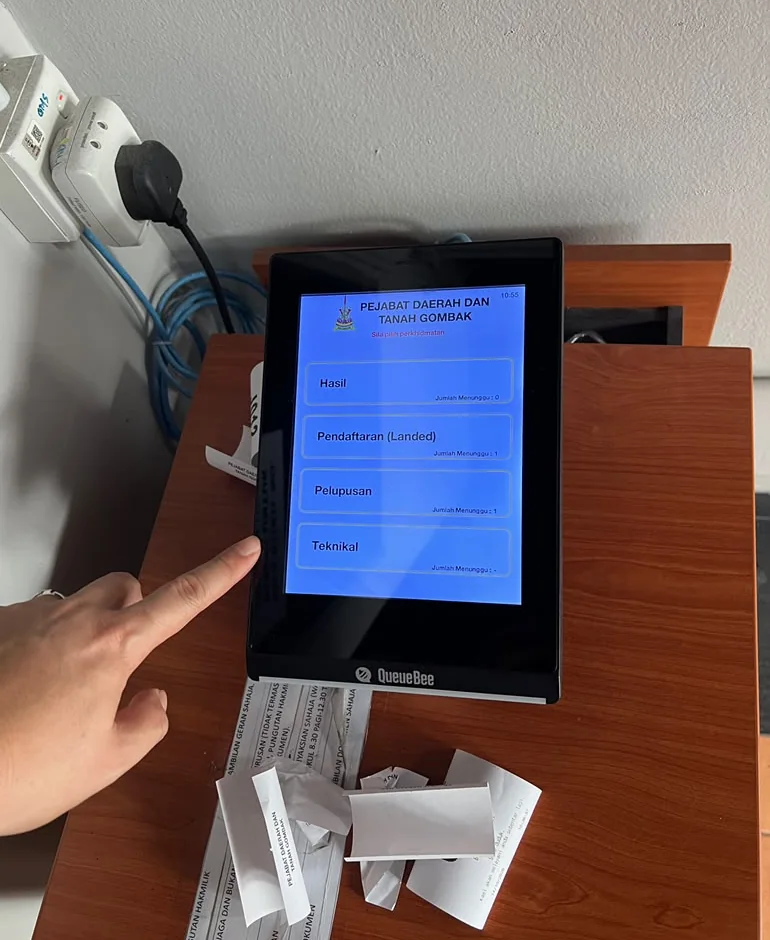
The title type tells you which office holds the record
Before you can search, you need to know where to search, and the title itself says so.
- Registry titles, held at the state Pejabat Tanah dan Galian: Geran (GRN), Pajakan Negeri (PN), and Hakmilik Sementara Daftar (HSD)
- Land Office titles, held at the Pejabat Daerah dan Tanah for the district: Geran Mukim, Pajakan Mukim, and Hakmilik Sementara Mukim
Searching the wrong one does not give you a wrong answer. It gives you no answer, and people lose days to it. The words are printed at the top of the title.
The Hakmilik Sementara entries are qualified titles, issued before the final survey has been completed and certified by the State Land Surveyor. They are real titles and dealings are registered against them in the ordinary way. The thing to carry forward is that the area on a qualified title is provisional, and on a purchase priced per square foot of land, a movement in area at final survey is a movement in money. Read what the sale agreement says about that before you sign it rather than after.
A search is a photograph, not a guarantee
This is the part that gets skipped and it costs real money.
A search is accurate at the moment it is issued. Nothing about it reserves the title, freezes it, or warns you about what happens next. A private caveat can be entered the following morning. A charge can be registered the following week. The register is live.
So the discipline is two searches, not one. Early, to decide whether to proceed at all. And again shortly before completion, to confirm that nothing has arrived in the interval. Your solicitor will do the second one as a matter of course. The failure is usually at the other end, where a search taken months earlier at the deposit stage is still being treated as current.
A buyer who has paid a deposit under a sale agreement is often advised to enter their own private caveat, precisely because the register is open to everybody else as well. Whether that is right in a particular transaction is a question for the solicitor, not for a website.
Before you pay anything
- Get the title number and lot number from the agent before the viewing, not after. A seller who will not release them has told you something
- Read the title type and work out which office holds the record
- Do a private search yourself as a first filter, before any booking fee changes hands
- Check the proprietor's name character by character against who is actually negotiating with you
- Read the expiry date on a leasehold title and subtract, then think about your exit rather than your entry
- Read the express conditions, not just the category, and test them against what you intend to do in the building
- Look for a restriction in interest and, if there is one, make sure the completion period in the agreement is built around the consent application
- Read every endorsement. Charge, lease, caveat. Ask for a redemption statement on the charge and an explanation of anything else
- On a qualified title, establish what happens to the price if the surveyed area differs from the stated one
- Search again before completion. Always
What this page is, and what it is not
This is what a title search contains and why each part of it matters on an industrial purchase. It is not conveyancing, and the fields described here are read against a particular title, in a particular state, with particular wording.
Express conditions in particular are drafted individually. Two titles in the same category, in the same industrial estate, can permit meaningfully different things, and only the words on the title you are buying are the words that bind you. Anything turning on what a condition permits, on whether consent will be given, or on a caveat already entered, is a question for a solicitor.
Related
- The area is provisional, the price is not, for what Hakmilik Sementara means when the area line on the title you are searching says Luas Sementara
- Industrial, commercial or residential, and what your title actually permits, which goes further into the three categories and the express conditions
- Leasehold or freehold, check the geran not the flyer, for the tenure field and what a shortening lease does to financing
- The fee buys a decision, the premium buys the category, for what changing a category actually costs
- One tax is on the land, the other is on the building, because the annual quit rent is printed on the face of the title you are searching
- A foreigner can buy a factory, not in their own name, where consent is a separate layer again
- Empty is not a discount, it is a question
- Versi Bahasa Melayu: carian hakmilik dan apa yang geran tunjuk
Frequently asked questions
What is a land title search in Malaysia?
It is a request to the land authority for what the register currently says about a particular title. Malaysia runs a Torrens system, so the register is not a record of who people say owns the land, it is the thing that makes them the owner. A search returns the current state of that record: the proprietor, the tenure, the land area, the category of land use, the express conditions and restrictions, and every charge, lease and caveat endorsed on it. It is the cheapest document in a property transaction and the only one that is authoritative.
What is the difference between an official search and a private search?
An official search, carian rasmi, produces a certificate issued and certified by the registrar, and the National Land Code provides a route to compensation where that certificate is wrong because of an error or omission. A private search, carian persendirian, is a faster and cheaper look at the same record, with no certificate and no such protection. Both normally show the same information on the day. The difference is what you can do about it afterwards if the record was reported to you wrongly, which is why the official search is the one solicitors obtain for completion.
Do I search at the land registry or the district land office?
The title type tells you. Geran, Pajakan Negeri and Hakmilik Sementara Daftar are Registry titles and are held at the state Pejabat Tanah dan Galian. Geran Mukim, Pajakan Mukim and Hakmilik Sementara Mukim are Land Office titles and are held at the Pejabat Daerah dan Tanah for the district the land sits in. Searching the wrong office does not return a different answer, it returns no answer, and people lose days to this. Read the words at the top of the title before you go anywhere.
What does a geran actually show?
The state, district and mukim, the title number and lot number, the land area, the annual quit rent as Cukai Tahunan, the tenure, the category of land use, the express conditions and any restrictions in interest, the registered proprietor and their share, and then the endorsements: charges, leases, tenancies, caveats and anything else registered against the land. The front page is description. The endorsements are where a deal lives or dies.
What is a restriction in interest on a land title?
It is an endorsement limiting what the proprietor may do with the land without permission. The common one on leasehold industrial land reads along the lines that the land may not be transferred, leased or charged without the consent of the State Authority. It does not stop a sale. It inserts a government decision into the middle of one, with its own application, its own fee and its own timetable, and consent is a decision rather than a formality. If a title carries one, the completion period in the sale agreement has to be written around it rather than hoping.
What is a private caveat and how long does it last?
A private caveat is a notice entered on the register under section 323 of the National Land Code, in Form 19B, by someone claiming an interest in the land. While it sits there the registrar will not register a dealing that would defeat the claimed interest, so in practical terms it freezes the title. It lapses automatically six years after entry under section 328 unless renewed. It can be withdrawn by the caveator under section 325, removed on application to the registrar under section 326, which gives the caveator two months to go to court, or removed by the High Court under section 327.
Can I buy a factory that still has a bank charge on the title?
Yes, and most industrial purchases are exactly that. The charge is discharged out of the purchase price on completion, with the seller's bank issuing a redemption statement and the money going there first. It is routine. What is not routine is discovering it late, because the redemption sum sets a floor under the price and the bank's own timetable sets the completion date. Ask for the redemption statement early. A seller who cannot say what is owed to their own bank has told you something about how the rest of the transaction will go.
Is it safe to buy land on a qualified title?
A qualified title, Hakmilik Sementara, is a real title that can be dealt with. It is issued before the final survey, so the area shown on it is provisional and the boundaries have not yet been certified by the State Land Surveyor. Transactions are registered against it in the ordinary way. The thing to understand is that the area can move when the final title issues, and on a price agreed per square foot of land, a movement in area is a movement in money. Read what the sale agreement says happens if the surveyed area differs from the stated one.
How long is a title search valid for?
It is accurate at the moment it is issued and no longer. A caveat can be entered the following morning, and a charge can be registered the following week. This is why a search is done at the start, to decide whether to proceed, and again shortly before completion, to confirm nothing has landed in between. Treating a search taken at the deposit stage as still good three months later is one of the more expensive assumptions in conveyancing.
Can I do a title search myself, without a lawyer?
You can obtain one, and for a first look before you commit to anything it is sensible to do so. Reading it is the harder half. The fields are in Bahasa Melayu, the express conditions are drafted narrowly, and the consequence of a restriction in interest or a caveat is not obvious from the words on the page. Use your own search to decide whether to keep going. Use a solicitor for the official search, the interpretation and the completion, because by then the question is not what the title says but what has to happen before it can be transferred to you.
References
- Laws of Malaysia, Attorney General's Chambers. The National Land Code governs registration, categories of land use, restrictions in interest and caveats, including the entry of a private caveat at section 323, withdrawal at section 325, removal on application to the registrar at section 326, removal by the court at section 327, lapse at section 328 and compensation at section 329. As with the other articles on this site, I was not able to open these from my own machine, so I am sending you to the source rather than quoting it as read
- Jabatan Ketua Pengarah Tanah dan Galian, and your own state Pejabat Tanah dan Galian, for search procedure, fees and which office holds a given title type. Procedure and fees are set by each state and differ between them
- Pejabat Tanah dan Galian Pulau Pinang, registration FAQ, which sets out plainly which title types are held at the state registry and which at the district land office, and the difference between a qualified title and a final title
- Malaysian Bar, Conveyancing Practice Committee, on the importance of a property title search, for the practitioner view of what a search reveals and why a fresh one is taken before completion
- A solicitor practising conveyancing in the state concerned, for the official search, the reading of the express conditions, and anything turning on a consent application or an entry already on the register
Note on this article. It explains, in general terms and as at 16 October 2026, what a land title search shows in Peninsular Malaysia and why each field matters on an industrial purchase. Search procedure, fees and the wording of express conditions and restrictions are set by individual states and by the particular title, and are not reproduced here. The title reproduced here is shown with its title number, lot number, plan and file numbers, barcode and serial number removed, and no owner, property or transaction is identified. I am not a solicitor or a licensed land surveyor, and nothing on this page is legal advice. The reading of a specific title, and anything turning on a caveat, a consent or a condition, is a question for a solicitor.